
Categories
ingles

Perfil (News)


Rentals: Are We Heading Toward a Flood of Lawsuits?

By Gonzalo F. Coira*

The rental market shouldn’t be a battleground—it should be a cooperative relationship between two parties. It’s a form of recklessness to allow tenants to remain indefinitely in a property through coercion, just as it’s absurd to expect them to own real estate. The solution? A tenant credit scoring system.

Landlords have welcomed the president-elect’s announcement to repeal the current Rental Law, while tenant advocacy groups are protesting what they see as the loss of rights and greater housing uncertainty.

But what’s actually true about each side’s claims? What has the market—and more importantly, the experiences of neighboring countries—taught us?

Let’s look at this as a trade-off and identify who really wins and loses (if anyone) in what is increasingly becoming an ideological, rather than practical, debate.


The idea of “freedom” in this context—pitted against tenants’ concerns about abusive practices by landlords—is, in fact, a misrepresentation. This belief has grown over past decades as the rental issue was framed as a “fight,” rather than as a mutually beneficial relationship between two interdependent parties.

First, rental prices are closely tied to average property values. But that’s not the only variable. Housing supply, access to credit, and—most critically—legal certainty and stability also play a major role.

Makes sense, right? That brings us to the root of the problem: the lack of certainty and legal security. The data currently circulating isn’t entirely accurate, but one thing is clear—there’s a 70% housing deficit. Around 40% of available units have been pulled from the market due to the Rental Law, and the remaining 30% represents inventory projected to return within the next 36 months.

Back to our key point: that 40% drop is directly related to the uncertainty and legal insecurity landlords feel. Many choose to exit the market or turn to short-term rentals for tourism as a safer alternative.

In this context, repealing the Rental Law would offer greater legal security to landlords and real estate investors. Even if it means sacrificing some profitability, the long-term gain is predictability—something that’s missing under the current system.

We’re talking about contractual freedom for both parties, but with reasonable limits—just as all successful models across the region do. For example, a minimum term of two years for urban leases is standard throughout the West and works well.

Should landlords be allowed to evict tenants at will, every month, based solely on opportunity? That wouldn’t be freedom—it would be outright abuse.

On the other hand, the extortion practiced by certain tenants—who threaten to remain in the unit indefinitely, leveraging the slow legal eviction process—is also abusive. This dynamic ultimately harms all renters, by shrinking supply and raising barriers to entry, even for a simple studio apartment.

What’s needed, as in any system, is balance—a fair play mechanism between two parties that actually need each other.

To encourage this balance, it’s time to implement a tenant registry—a sort of “tenant Veraz” or credit scoring system—so that landlords can assess rental behavior. Above all, we need legislation that streamlines the eviction process.

This would also resolve landlords’ demand for personal property guarantees from tenants—an illogical and burdensome requirement, especially for renters who obviously don’t own property.

Such initiatives would boost housing supply and encourage new residential development, which in turn would drive down rental prices and offer tenants more options and greater housing security.


Attorney – Master’s in Bankruptcy & Corporate Reorganization, MIT Honors Recipient, Fire Hydrant Award Winner, CEO & Founder of Pedro Te Compra.

Categories
ingles

La Nación (Newsletter)

December 1, 2023

An Argentine Entrepreneur Wins Prestigious MIT Award for a Game-Changing Real Estate Innovation

Gonzalo Coira becomes the first Argentine to receive MIT’s Fire Hydrant Award for his revolutionary ‘Pedro Method’. Here’s what it’s all about.

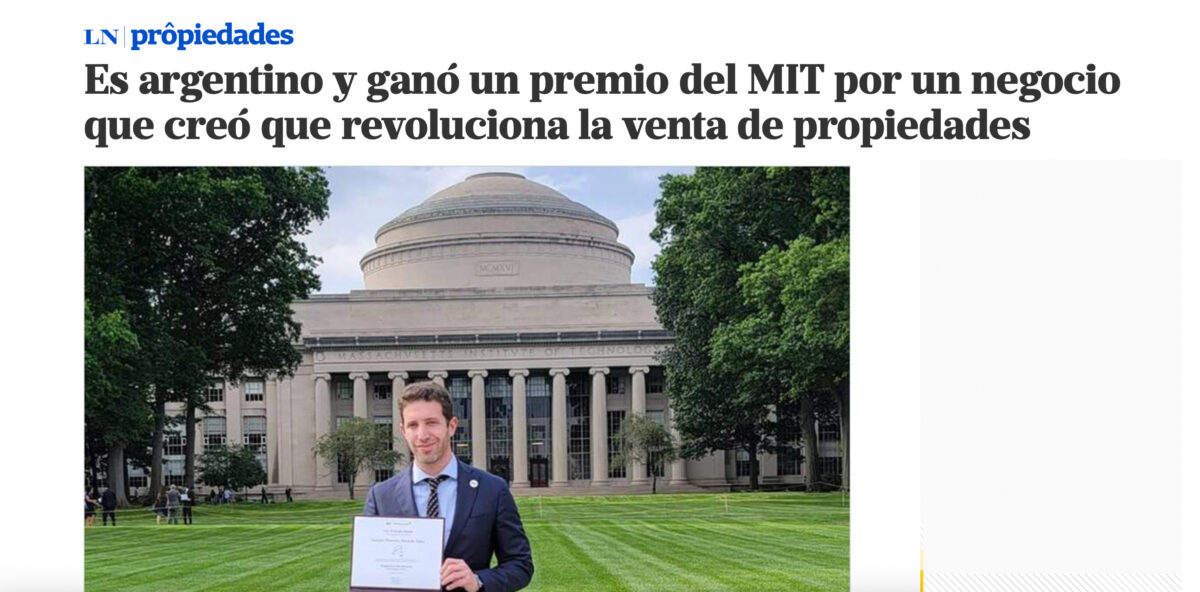
In August 2023, Gonzalo F. E. Coira, a law graduate from UCA and an MBA from IAE Business School, became the first Argentine to be honored with the Fire Hydrant Award. This recognition came from the prestigious educational and research institution based in Cambridge, Massachusetts: MIT.

At 39 years old, Coira stands out not only for his academic achievements but for a deeply personal journey that shaped his entrepreneurial path. His road to success emerged from a groundbreaking solution to the first-home crisis, capturing the attention of both tech experts and thought leaders.

Coming from a family of doctors, his life changed dramatically in 2001 when his father was hit by Argentina’s economic crisis and the family business went bankrupt. “That was a turning point,” Coira recalls. “I saw how tax pressure and employment instability weren’t aligned with support for the middle class.” Motivated by this perceived injustice, Coira chose to study law, becoming the first lawyer in his family, eventually specializing in commercial law, particularly insolvency and bankruptcy.

During the 2008-2009 U.S. financial crisis, Coira took a bold leap and moved to the United States. “I sensed an opportunity in real estate. The market was saturated, and banks were absorbing distressed mortgages,” he recalls. He headed to Detroit, Michigan—a city he saw as both challenging and full of potential.

The Birth of an Idea

Back in the 1980s, Detroit had a population of 2 million. Today, that number is just over 600,000. “Homes were practically being given away. Suburban houses were selling for as little as $6,000 or less,” says Coira. During his time in the U.S., he worked at a company that acquired and sold homes to vulnerable populations. “That’s when I realized the biggest barrier was a cultural resistance to homeownership,” he explains.

With the support of Section 8—a U.S. housing assistance program offering rental vouchers—tenants were receiving $700 to $800 monthly. In many cases, the rent-to-value ratio meant these tenants could buy the homes they were living in. “It was an incredible opportunity. In six months, they could own the property outright. The challenge was changing their mindset and encouraging them to buy,” Coira recounts. He later replicated the approach in Atlanta before returning to Argentina a year and a half later.

That experience, which helped over 500 families become homeowners, sparked the creation of the “Pedro Method”—a system designed to facilitate first-time homeownership for low- and middle-income individuals. At 26, Coira returned to Argentina and founded his own company, planting the seed for what would later earn him international recognition.

Building the Platform

Coira developed a digital platform called “Pedro Te Compra” (Pedro Buys Your Home), or PTC. The project centers around an algorithm that connects individuals or companies in urgent need to sell with buyers looking for affordable entry into homeownership.

“That’s when I created the figure of Pedro,” Coira recalls. Pedro is a bearded, middle-aged fictional character designed to be friendly and trustworthy. “I wanted to personify the experience so buyers felt guided and supported. I enrolled in an MBA and began testing the concept.”

Whenever the platform went live, it received over 1,000 daily requests from people wanting to sell—without any advertising. The system offered non-binding offers based on reference prices and discount codes. Once accepted, the algorithm would immediately connect the seller with a potential buyer. These early tests were successful but required significant investment and technology to handle big data efficiently.

To further strengthen the project, Coira pursued a Master’s in Leadership and Innovation in Boston, in a program co-developed by MIT faculty and Global Alumni. The final project required students to propose a scalable social-impact initiative. “It was an incredible experience. I pitched my idea, and the team loved it,” he says.

He and his team spent over a year and a half refining the platform, leveraging technologies like Blockchain, cloud computing, Artificial Intelligence, and ChatGPT. What solidified PTC’s success, Coira says, was its alignment with the UN’s Sustainable Development Goals (SDGs), especially affordable housing and wealth inequality.

Eventually, he presented the final version to a panel of judges and was awarded the Fire Hydrant Award by MIT Professional Education. “The response was overwhelming. The applause at the end was unforgettable. It felt like everything had fallen into place,” he reflects. For years, the complexity of this project had felt insurmountable without AI tools to manage the vast data processes involved.

Today, Coira and his team are in talks with two U.S. investment funds interested in backing the platform. Although he still practices law, 70% of his time is now devoted to PTC. “I love being a lawyer, but I hope to one day dedicate myself entirely to Pedro, given its significant social impact,” he says.

The platform is set to launch in April 2024, operating in both Florida and Buenos Aires. After extensive field testing, it’s almost fully functional. “We’re finalizing deals with collaborator

Categories
ingles

Forbes

December 1, 2023

Brilliant Ideas: MIT Awards Two Argentinians for Their Groundbreaking Innovations

Leandro Mbarak and Gonzalo F. Coira receive the prestigious Fire Hydrant Award from the Massachusetts Institute of Technology (MIT)

Demonstrating exceptional innovation and deep local expertise, two Argentinians have achieved international recognition in the field of technology. Their accomplishments stem from the successful completion of the inaugural Executive Certification Program in Digital Transformation offered by the renowned Massachusetts Institute of Technology (MIT).

Leandro Mbarak and Gonzalo F. Coira were honored with the esteemed Fire Hydrant Award, a distinction reserved for participants who exhibited outstanding leadership and a strong commitment to excellence throughout the program, in alignment with MIT’s core values.

Transforming Real Estate

Gonzalo F. Coira, founder and CEO of PTC, suggested that his team present the PTC platform (“Pedro Te Compra”), a real estate solution he had been developing for over four years. The platform leverages cloud-based services and artificial intelligence to address the first-home ownership crisis, particularly in developing countries.

The PTC project was adapted to align with MIT’s certification standards, incorporating advanced technologies such as generative AI. This AI is capable of answering questions related to legal processes, documentation, taxation, and administrative procedures involved in real estate transactions, simplifying and educating users throughout the property acquisition journey.

Coira is a lawyer, graduate of the Pontifical Catholic University of Argentina, specialized in commercial law, contracts, bankruptcy, and insurance. With more than 14 years of experience, he has been involved in numerous liquidation processes across the U.S., Uruguay, and Argentina.

He earned an MBA from IAE Business School, receiving special honors for his final thesis, which focused on converting underutilized urban centers into affordable housing for the middle and lower-middle classes.

He also lived in Detroit, Michigan, where he was part of a corporation dedicated to buying and selling homes for vulnerable populations, restructuring mortgage debt, and facilitating access to homeownership for underserved communities.

The Development of Pharma.ia

Leandro Mbarak, a member of the MIT team, was also recognized for his contributions to PTC, particularly in the area of AI. Additionally, he leveraged MIT’s career development support and the team’s management input to launch a new startup: Pharma.ia.

This innovative company focuses on AI-powered solutions for the pharmaceutical industry, such as intelligent drug leaflets designed to interact with patients, enhancing both their experience and safety throughout treatment.

Mbarak holds a degree in Chemical Sciences from the University of Buenos Aires and a Master’s in Innovation Engineering from the University of Bologna. He lived in Italy for three years, working for the multinational consulting firm CTPSYSTEM, where he became Site Manager. In 2008, he co-founded Latinoamérica Consultores, a firm he has led ever since.

With over 24 years of experience in the pharmaceutical sector across 18+ countries, he has worked in areas ranging from process engineering and improvement to IT system implementation and validation.

Recognizing Excellence

The Fire Hydrant Award celebrates innovation and impact across industries. Receiving this award is a testament to both recipients’ dedication, talent, and vision. Their work with PTC was recognized as a significant contribution to the tech landscape.

Both professionals have distinguished themselves through academic excellence. “What we achieved is the result of blending our knowledge and expertise, propelling our ventures to the global stage,” they affirm.

Both platforms aim to become changemakers in their respective industries—and perhaps even future unicorns. With cutting-edge technology and a user-centric approach, they represent major strides toward democratizing housing access and improving healthcare delivery.